
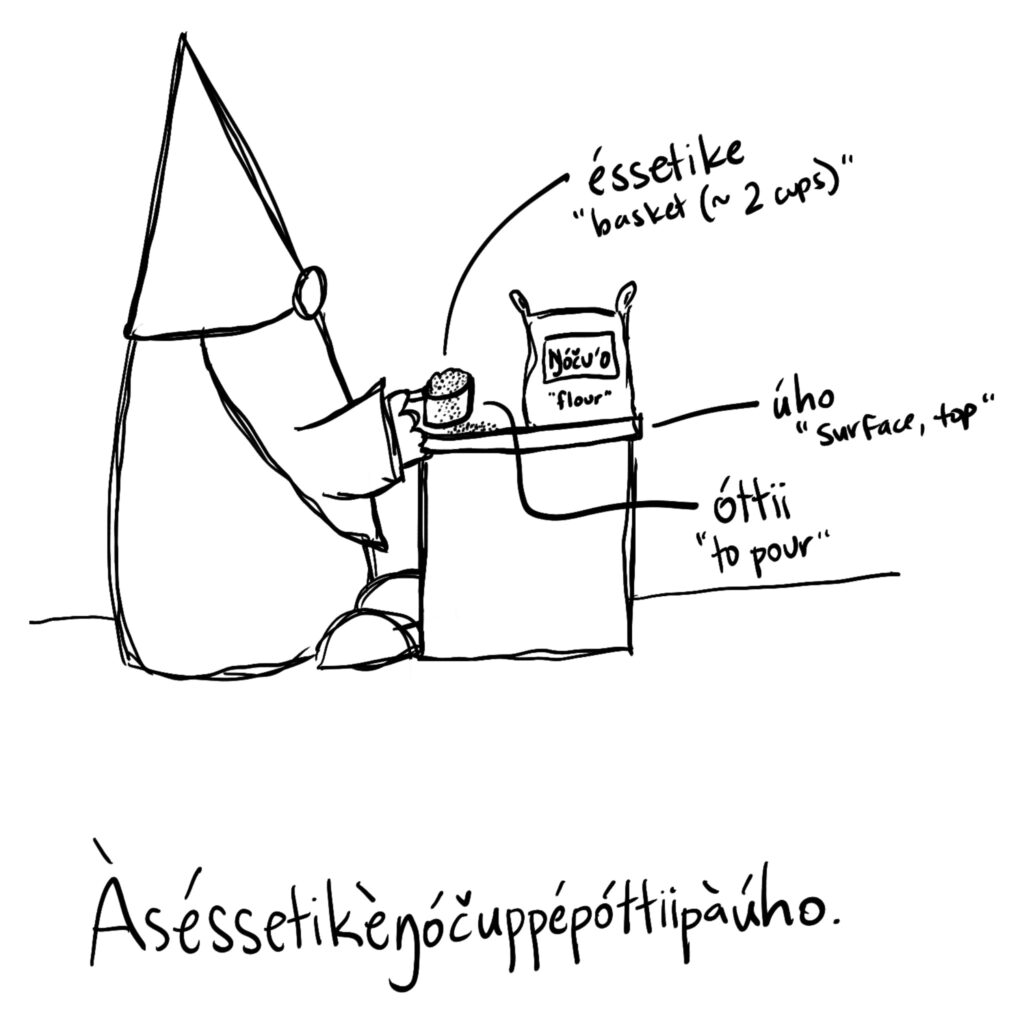
Àséssetikèŋóčuppépóttiipàúho. “Pour 2 cups of flour onto a surface.”
For today’s entry, I needed to think through how the nisse would measure ingredients, and I decided they would have their own system. Who needs the metric system, anyway?
I created units based on how they might gather/measure ingredients, including the word éssetike “basket” being used to indicate roughly two cups’ worth of something. (While creating this system, I needed to be mindful of the fact that the nisse are much smaller than humans!) The word basket is an instrumental noun built on the verb þétike “to gather, to collect”.
The measurement words can be followed by the linking particle è(h)- and the noun being measured, as in éssetikèŋóču’o “a basket of flour,” where ŋóču’o is “flour”. The noun “flour” is a patientive nominal built on the verb čú’o “to grind”.
Finally, the verb óttii “to pour” features the change-of-location applicative attached to the verb root tíí “to turn over, to flip over.”
I already had the words úho, which means “top (of a table)”, and pà, a preposition indicating motion towards a location.