
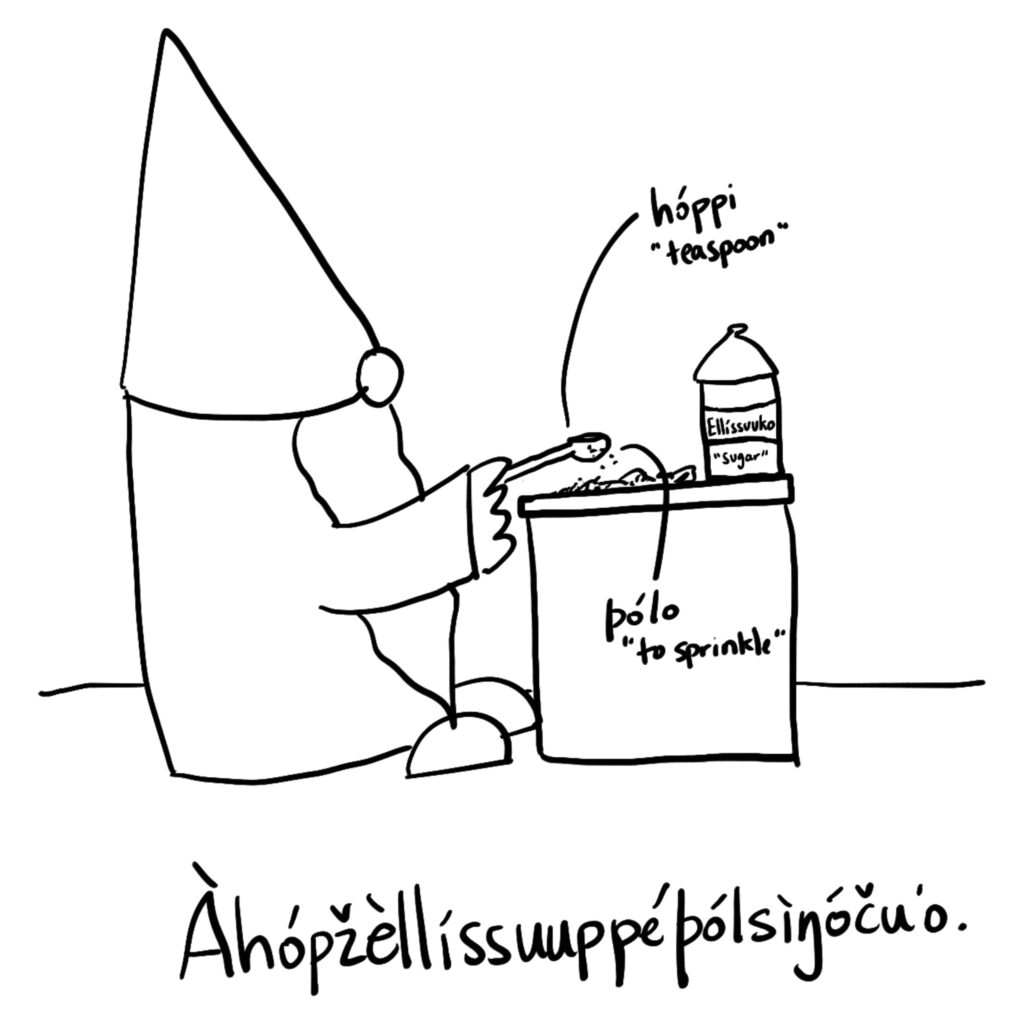
Àhópžèllíssuuppéþólsìŋóču’o. “Sprinkle a teaspoon of sugar over the flour.”
This sentence makes use of two words I created yesterday: hóppi “teaspoon” (which comes from the word “spoon,” a diminutive form of hópo “bowl”) and ŋóču’o “flour”. The form hóppi is affected by sound changes in the phonological environment of the full clause structure, where the sequence fiè undergoes these shifts: fiè > fjè > fžè > žè.
Grammatically, it also incorporates the non-core object marker š-/sì-, which can indicate a location, as in this instance (“over/on the flour”), direct object marker à-/às-/àh-, the linking particle è(h)-, and the imperative pé(p)-.
The new words I created today are þólo “to sprinkle, to scatter, to strew”, which is a basic root verb, and ellíssuuko “sugar”, which is a compound. The compound consists of ellíse “grain, granule” and þúúko “sap” (i.e. sugar is sap granules).
Sound changes affect the combined form, where sequence sþ becomes the geminate ss. And then sound changes further affect how “sugar” appears in the actual sentence: both the initial and final e disappear (they are epenthetic and only appear in word boundaries), and the sequence kp becomes the geminate pp. Thus, in this particular sentence, “sugar” occurs as -llíssuup-.