

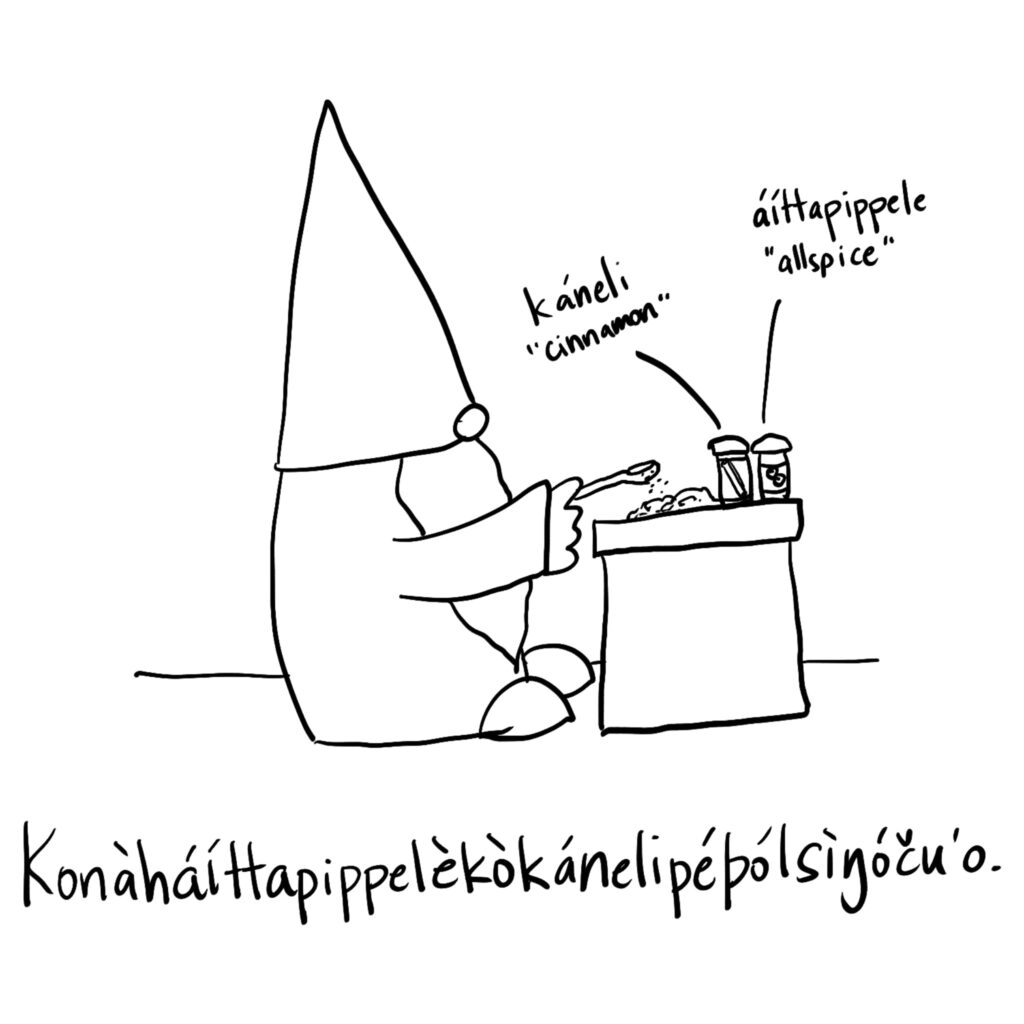
Konàháíttapippelèkòkánelipéþólsìŋóču’o. “And sprinkle allspice and cinnamon over the flour, too.”
Today’s featured sentence only needed two new words: allspice and cinnamon. Because these spices are not native to the Finland area where my nisse speakers live, these words were borrowed. The word káneli “cinnamon” was directly borrowed from Finnish (also kaneli) while the word for allspice is a calque of the Finnish compound maustepippuri (literally “spice-pepper”).
To create this calque, I created a native word for “spice”, áítta, which is an augmentative form of áíte (“taste, flavor”). And then I chose to borrow pipper from Old Swedish (the same source for Finnish pippuri). Not having an [r] in the language, it came into Nómàk’óla as pippele (the final [e] is epenthetic and only occurs at a word-final boundary).
Together, then, the compound áíttapippele is “allspice”.
The clause-initial ko(n)- is an additive clausal coordinator. To join two noun phrases, the linking particle è- and the preposition kò-, which is also the comitative, occur between the nouns being joined.