

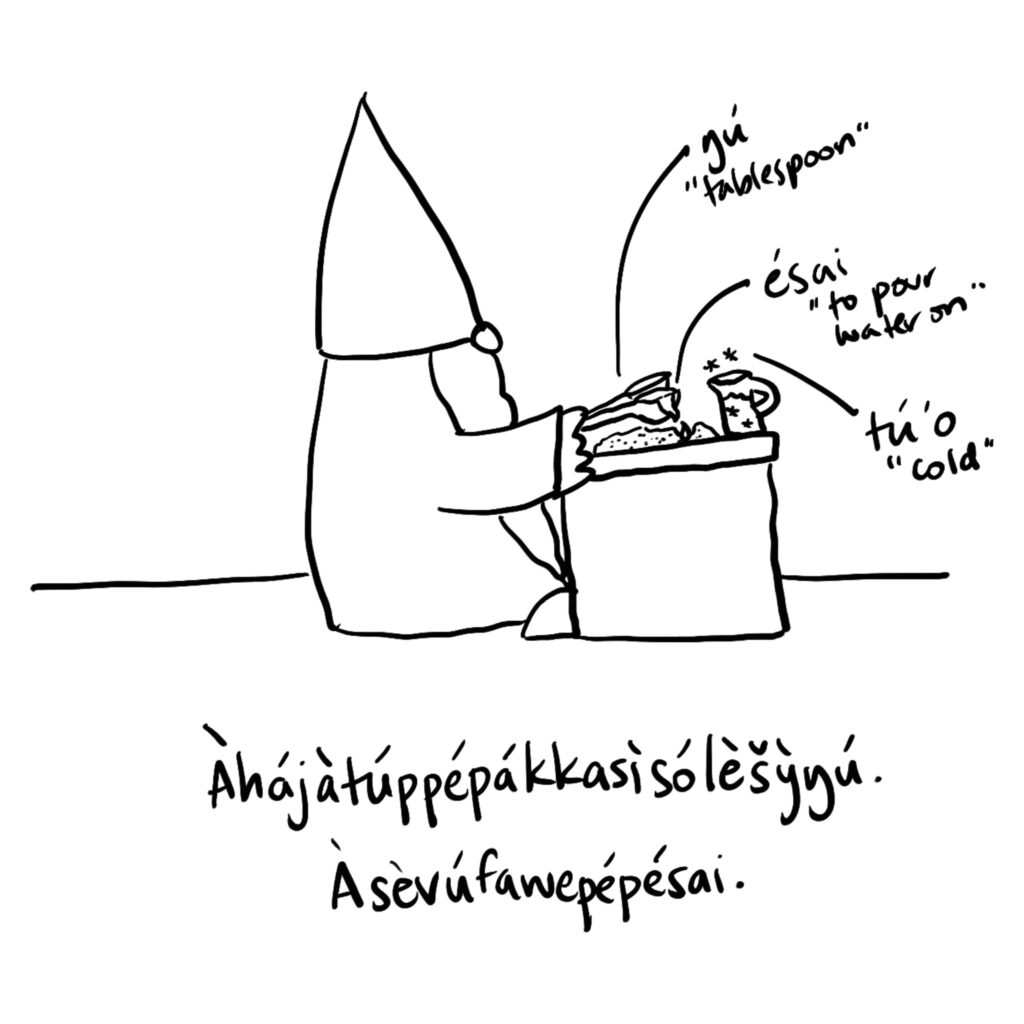
Àhájàtúppépákkasìsólèšỳŋú. Àsèvúfawepépésai. “Measure two tablespoons of cold water. Pour the water onto the dry ingredients.”
Nómàk’óla tends to separate heavy pieces of information into multiple clause structures, and something like “two tablespoons of cold water” turns into a rather chunky noun phrase with multiple nominal modifiers. And so today’s bit of directions was split into two distinct clauses and made use of the handy verb ésai, which means “to pour water on” (it is an instrumental verbal derivation added to the root áí, meaning “water”). The core object is then the location for said pouring, which in this case is the pile of dry ingredients.
The first clause features the verb ákka “to measure”, which combines a reiterative derivational suffix and the verb root áhe “to hold (in the hand)”. The basic idea is that early measurements would have been performed using hands.
That ties in nicely with the word ŋú, which means “hand” in most contexts, but in the world of measurements, it means roughly a tablespoon. I figured a nisse hand would easily and comfortably hold about a tablespoon’s worth when cupped. This word is at the end of the first clause, as part of a non-core object phrase: the verb ákka takes the object being measured as its core object, and the specified measurement occurs in a non-core object phrase. To specify two tablespoons, the cardinal number (which is treated as a noun) occurs first (sól- “two”) followed by the linking particle è-, the non-core object marker š-, and the noun being counted (ỳŋú “tablespoons”).
Going to the beginning of that clause, both áí “water” and tú’o “cold, coldness” are nouns, so the phrase “cold water” incorporates an appositional nominal modifier. Both nouns occur with the appropriate case-marking, and the noun deemed most important for the context occurs first (in this case, áí, where the i becomes j before the a vowel).