

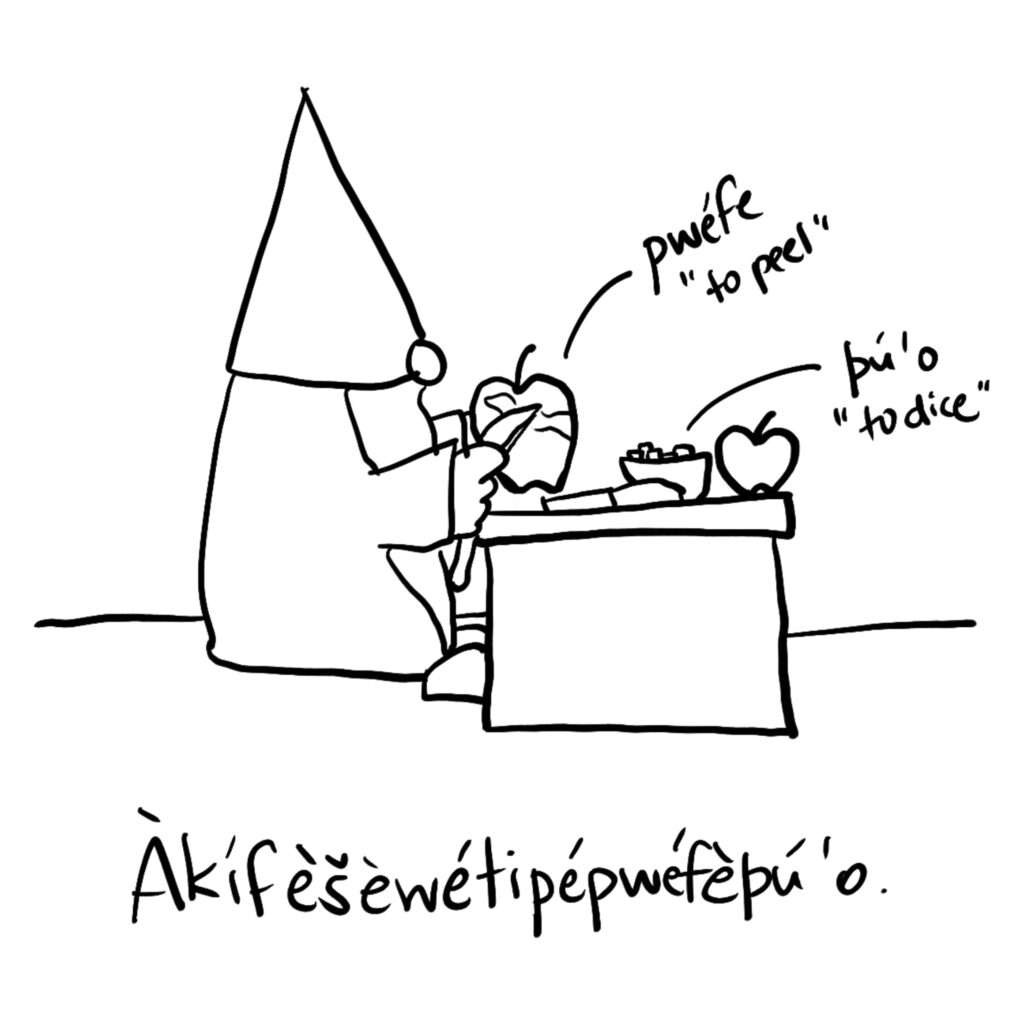
Àkífèšèwétipépwéfèþú’o. “Peel and dice three apples.”
I decided to create the root éti that originally referred to any tree fruit but then because apples were the most common, the word narrowed to refer to apples more specifically. Now if you want to refer to tree fruits in general, you use the reduplicated éčeti.
This isn’t the first example with a noun being counted, but I can’t remember if I explained that system in these Lexember posts yet. When counting nouns, the cardinal number is the head word, which, in this case, is kífe “three”. To indicate the noun being counted, you need to use the linking particle è- followed by the non-core object marker š-, plural marker èw-/ỳ-, and the noun. And so “three apples” is kífèšèwéti.
I also needed verbs for “peel” and “dice”. Both ended up being basic roots. The verb pwéfe means “to peel” or “to strip” (as in to strip bark from a tree). The verb þú’o means “to chop with a knife” (rather than to cut with a more swiping motion) and can be used to mean “to dice” in recipes. Because nisse mouths are small, they are more likely to dice ingredients than to leave them in bigger chunks. So if they want larger chops, they would have to specify that.