

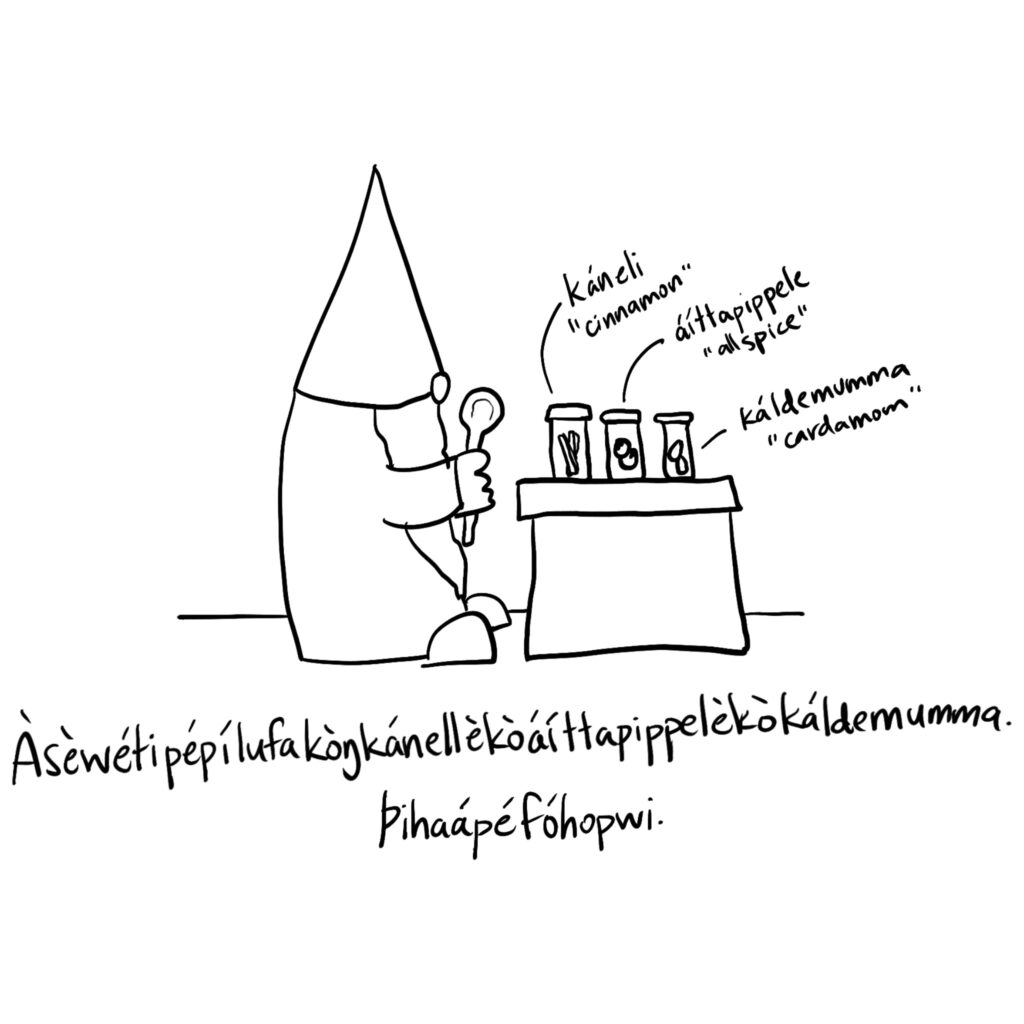
Àsèwétipépílufakòŋkánellèkòáíttapippelèkòkáldemumma. Þihaápéfóhopwi. “Sprinkle the apples with cinnamon, allspice, and cardamom. And then stir.”
This entry starts with a humdinger of a clause because it’s got three longer borrowed words all functioning as the object of the preposition kòŋ- (“with, using”). Like kánelli (“cinnamon”) and áíttapippele (“allspice”), cardamom is not native to Finland, so there is no basic or even semi-basic word in Nómàk’óla for this spice. The word káldemumma (“cardamom”) is borrowed from Finnish kardemumma.
That explains the latter two-thirds of the first clause. The clause begins with the core object marker às- followed by the plural marker èw- and the noun éti (“apple”). Next is the imperative pép- and then the verb ílufa, which is a new verb for the language.
I added the resultative verbal derivation íl- to the noun úfa (“dust”) to create the verb “to dust, to sprinkle.” The core object of the verb is the thing being powdered, and any substances being powdered are indicated by a preposition phrase headed by kòŋ- (hence, the rest of the clause!).
The second clause consists of pieces already created in the language and is kicked off by the clausal coordinator Þih- (“and then”). The object marker merges with the pronoun á (“it, them”) to create a long vowel with a shifting tone from mid-to-high: aá-. The verb of that clause is fóhopwi (“to stir”). After the first clause, this baby clause is a sigh of relief!