

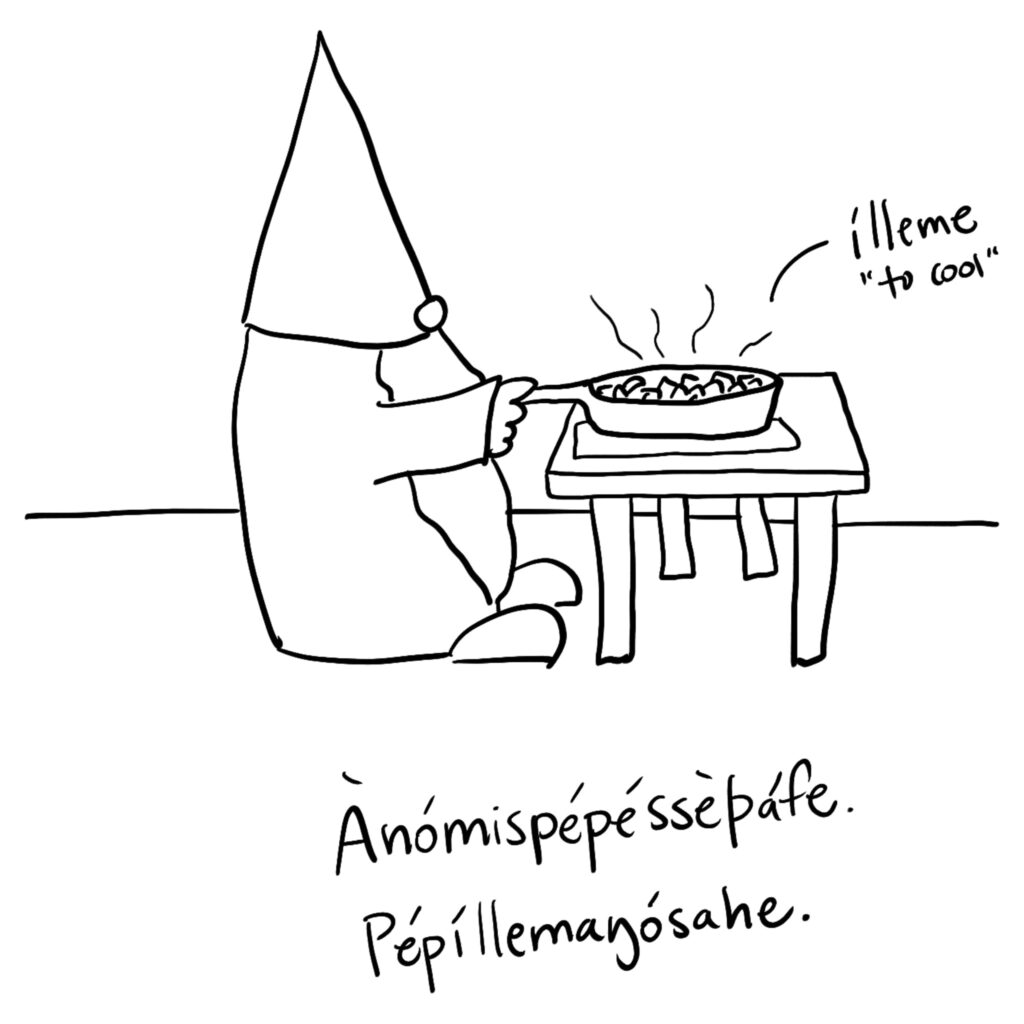
Ànómispépéssèþáfe. Pépíllemaŋósahe. “Remove the skillet from heat, and let the mixture cool.”
The first clause more literally translates as “move the skillet away from heat”. While all the pieces already existed in the language when I translated this today, I can’t quite remember if I had previously introduced the verb ése “to move”, and I am fairly certain I had not yet used lè- “from, away from, out of” in a Lexember entry yet. (NB: Due to sound changes, lè- occurs as sè- in the clause.)
For the second clause, I needed a verb that meant “to cool” in the sense that a hot dish is coming down to room temperature. I created an old root wéme that means “middle, center” but is dated in that particular use. More currently, it’s used to refer to a middling state of affairs, such as tepidness of temperature or fairness of opinion without extreme bias. Adding the verbal resultative prefix íl- to it creates ílleme, which in this case is used to mean “to cool” or “become more middling”.
As with other similar examples, to get the “let it VERB” reading, the imperative prefix co-occurs with verb indexing and an explicit subject, which you can see with the third-person inanimate -a suffix and the nominal subject ŋósahe (“mixture”).