

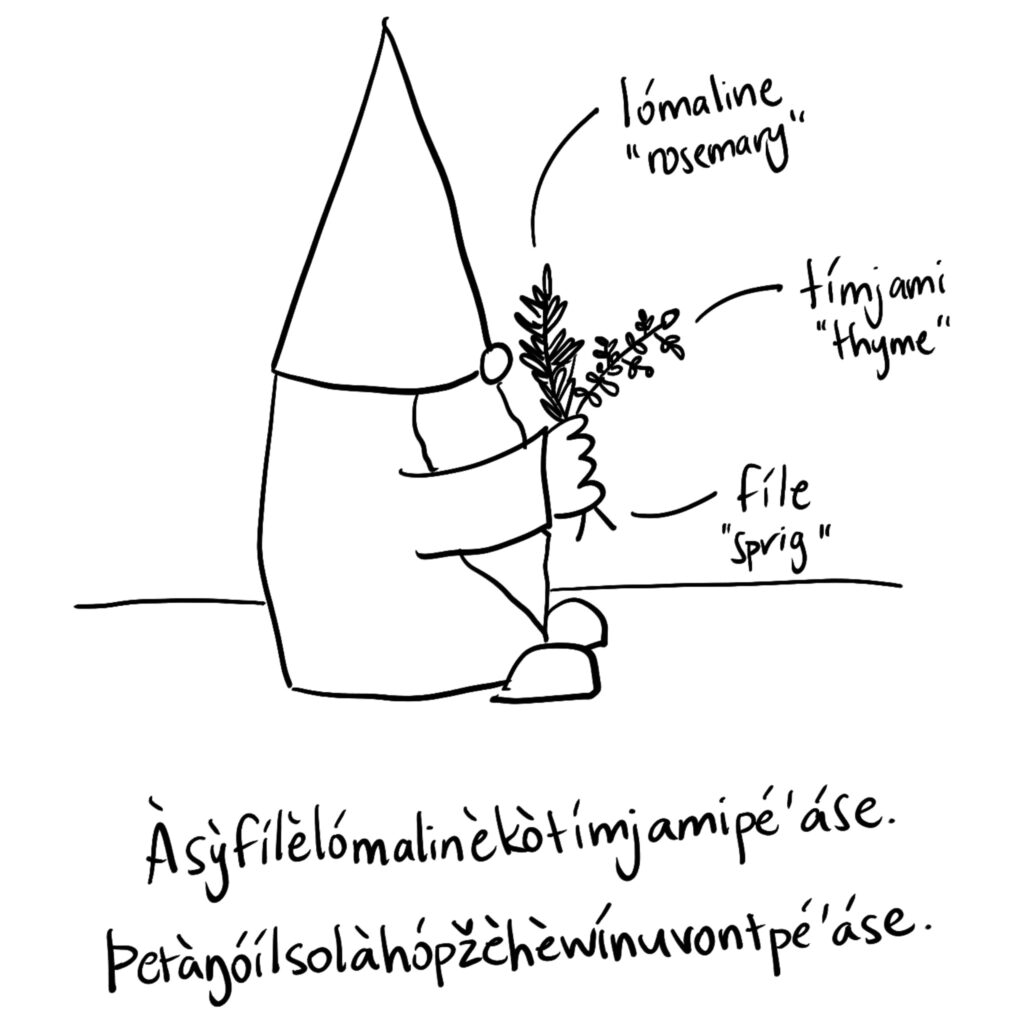
Àsỳfílèlómalinèkòtímjamipé’áse. Þetàŋóílsolàhópžèhèwínuvontpé’áse. “Add sprigs of rosemary and thyme. Or add 1/2 teaspoon of dried herbs.”
Today’s entry was a fun one, requiring three new words and a handful of constructions I haven’t used yet (or at least not often).
I extended the meaning of fíle “grass, blade of grass” to also mean “sprig” in the context of herbs or flowers—a grass of rosemary is a sprig of rosemary.
Neither rosemary nor thyme are native to Finland, so I borrowed those words. I borrowed lómaline “rosemary” from Swedish rosmarin (there is no r in Nómàk’óla, so those shifted to l, and a sound change resulted in the s being lost) and tímjami “thyme” from Finnish timjami.
I had created a way to say “half of” previously, but I hadn’t used it yet. Today is the debut of ŋóílsolo “half”, which is followed by an appositional noun phrase if the “of something” is specified. Here, it is followed by hóppi “teaspoon” (sound changes result in its form turning to hópž- in context).
I created a new compound for “herb” or “dried herb” more specifically, coming from “dry leaf”: ínuvono.
This is one of my favorite drawings yet—there is something so satisfying about seeing those little sprigs of herbs in the hand of a nisse chef. 🙂