

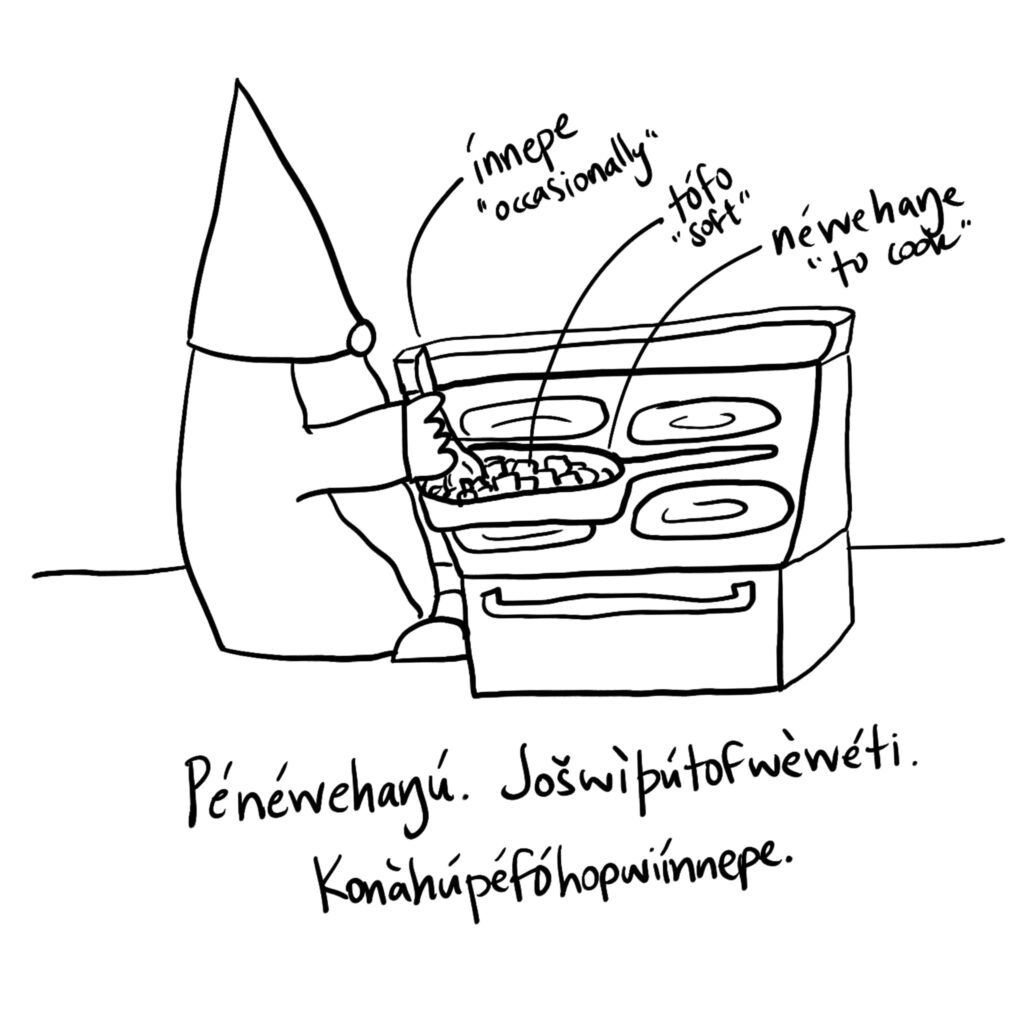
Pénéwehaŋú. Jošwìþútofwèwéti. Konàhúpéfóhopwiínnepe. “Let the apples cook until they are soft. Stir them occasionally.”
I already had the transitive verb éhaŋe “to cook” in Nómàk’óla, and the first clause features its reflexive (intransitive) form: néwehaŋe. The “let them VERB” construction is formed with the imperative prefix and a specified subject. In this case, the subject is the apples, which is expressed as a pronoun in this first clause. The pronoun is the third-person plural nisse form ú.
The second clause is a subordinate finite clause, occurring with the initial još- and followed by a full clause. One new word I needed for this was the adjective “soft”, tófo, which occurs with the copulative derivation þú- to make it a predicative verb (“be soft”).
I also needed an adverb meaning “sometimes” or “occasionally”, and I took inspiration from the Finnish word välillä, which comes from a nominal root meaning “space” or “gap”. I created the noun népe meaning “gap, space, interstice” (which also resulted in the new preposition né(p)- “between”). I added ík- (“to stretch”), which grammaticalized to the preposition ì- (“for, during, through, throughout”), to create the adverbial phrase ínnepe (“at times, sometimes, occasionally”).