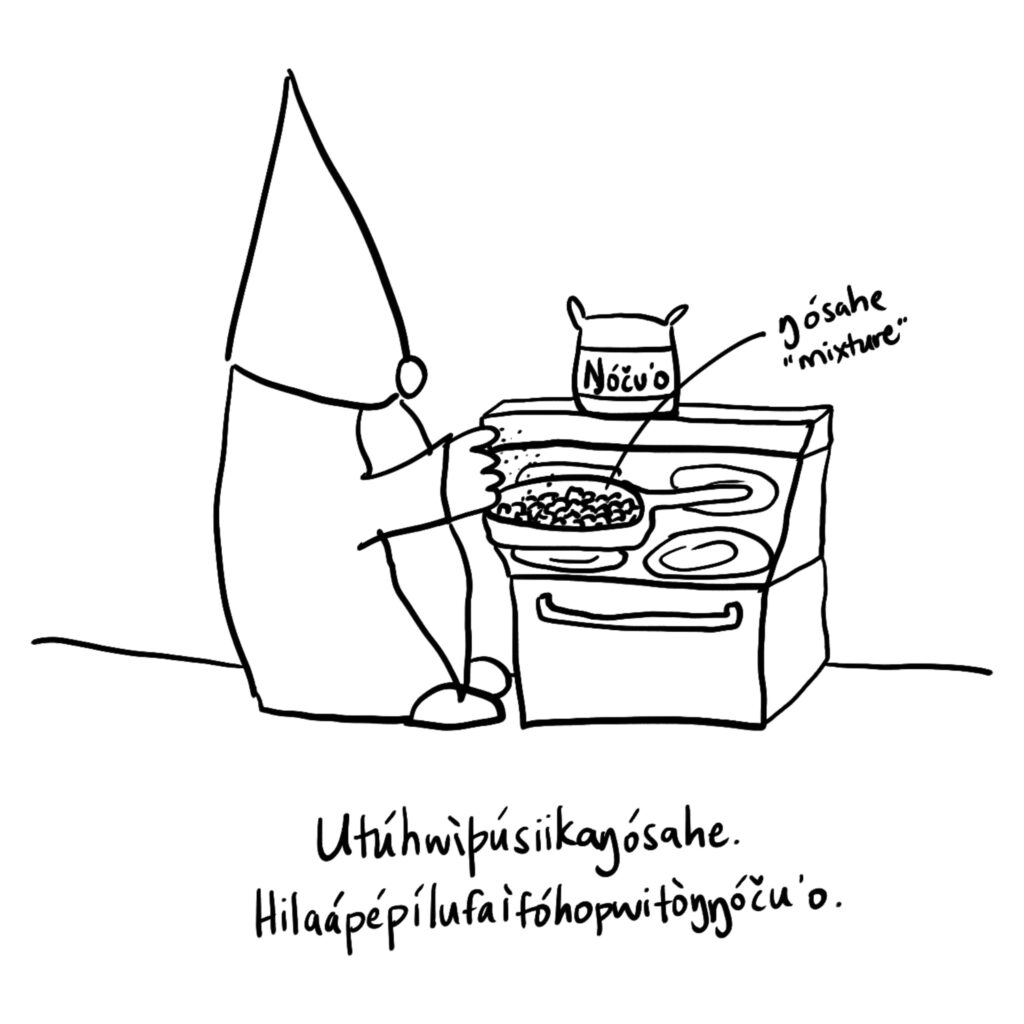
Utúhwìþúsiikaŋósahe. Hilaápépílufaìfóhopwitòŋŋóču’o. “If the mixture is wet, sprinkle and stir flour in.”
Today’s Nómàk’óla directive features the correlative clause conjunction u- … hil-, which typically translates as “because … and so”. However, when paired with the subjunctive tú- in the first clause (the clause marked with u-), the translation shifts to “if … then”.
I created two new words to complete the first clause: (1) sííte (“wet”), which becomes þúsiite “is wet”, which in turn shifts to þúsiik- when followed by the third-person inanimate -a marker; and (2) ŋósahe (“mixture”), which features the patientive nominal prefix ŋó- and the verb root sáhe (“to mix”).
The second clause consists of pieces already introduced and features a serial verb construction to connect ílufa (“sprinkle”) and fóhopwi (“stir”). The linking particle è- becomes ì- due to the a directly before it (they merge to create a diphthong with a mid-to-low falling tone). The core object of both verbs is the mixture (it is being powdered with flour and stirred with flour), which is represented by a third-person inanimate pronoun in the object slot. The flour (ŋóču’o) occurs with the instrumental preposition tòŋ-.
And that leads me to another thing… I made a mistake in the post from two days ago! The preposition “with” should be tòŋ- and not kòŋ-, as it appeared in the drawing and post. I know exactly why I made the mistake—while instrumental “with” is tòŋ-, comitative “with” is kò-. I conflated the two forms as I worked, and am left with a drawing that has an incorrect form in it. Alas…