

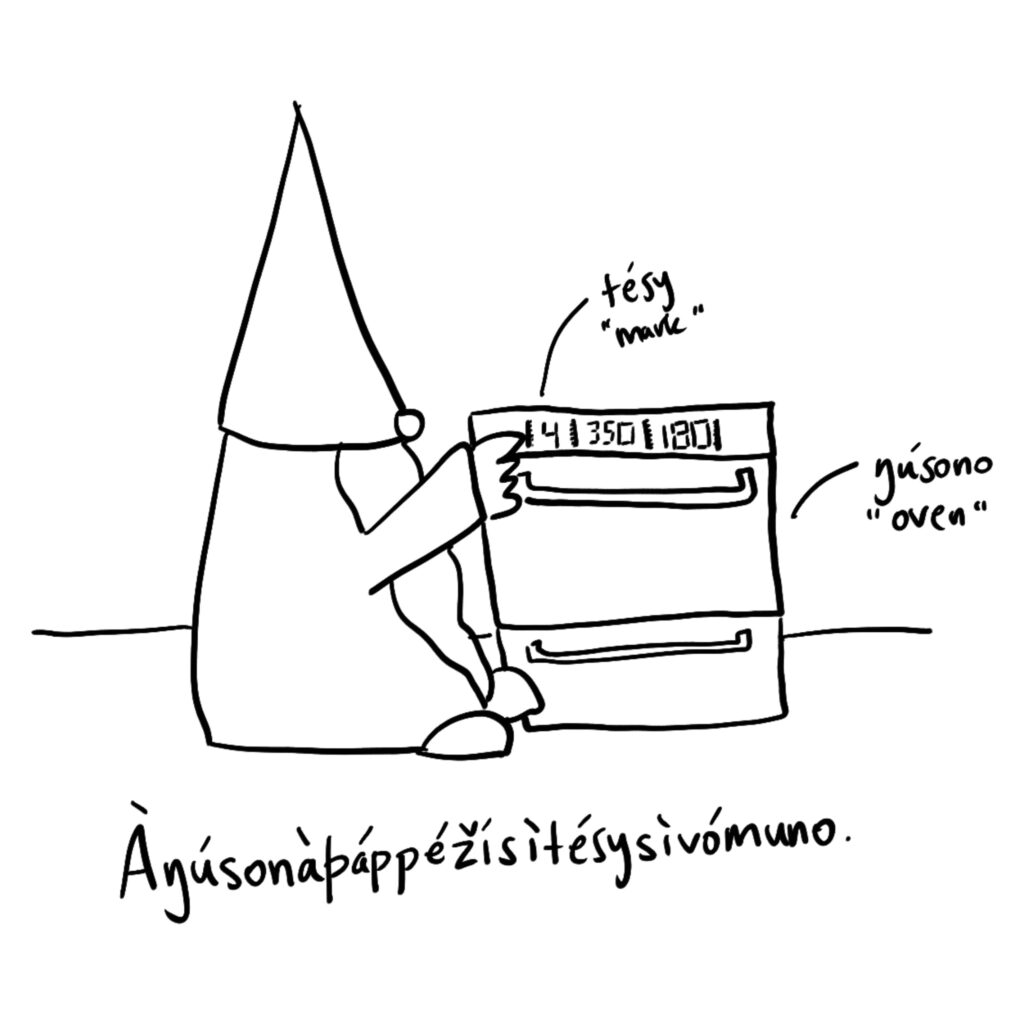
Àŋúsonàþáppéžísìtésysìvómuno. “Set the oven to (gas) mark 4.” **
Today’s Nómàk’óla entry more literally translates to “Set the oven heat to the fourth mark.”
While I created a word for “stove” earlier this month, I hadn’t yet created a word for “oven”. I wanted them to be distinct because my nisse historically cooked food on a stovetop (like a fireplace stove top) but baked breads in pits heated by coal. (This was inspired by the Icelandic bread-baking tradition, which uses natural heat from volcanic hot springs. Lacking the volcanic heat, the nisse used hot coals and covered the pit to create a little underground oven.) Therefore, the word sóno “to bake” comes from the older root meaning “to cover”. Adding the nominal instrumental prefix to that creates ŋúsono “oven”.
I also needed a word to indicate “gas mark” and decided to use a more generic “mark” instead. I had the verb sý “to count, to tally” already and added the locative nominal prefix to create tésy to mean a tally mark or any numerical mark on a surface (e.g. number on a clock face, number on a telephone dial).
The ordinal number vómuno “fourth” is treated as an appositional noun modifier, which means it carries the same case-marking as the head noun and occurs directly after the head noun. You may note that “oven heat” is the same kind of appositional phrase—both are marked with the core-object prefix and occur one after the other.
**Gas mark 4 is roughly equivalent to 350° Farenheit or 180° Celsius, which is why the oven in the image has all three numbers on it.