

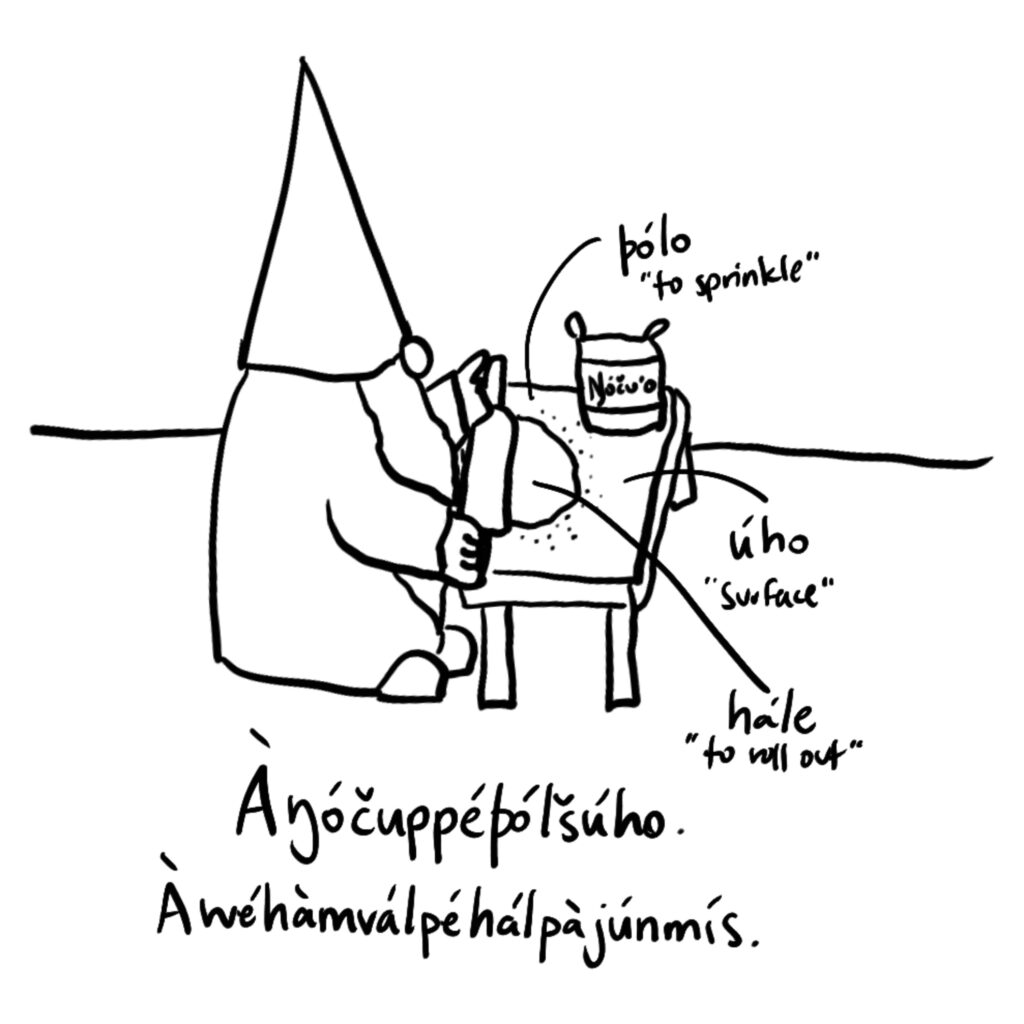
Àŋóčuppéþólšúho. Àwéhàmválpéhálpàjúnmíse. “Sprinkle flour onto a surface. Roll a ball of dough into a thin disc.”
In the first clause, I used the word úho, which means “top” but specifically a top of something standing that is more or less flat, like the top of a table or the back of a four-legged animal. In this case, I more generally define it as “surface”, as it may be a tabletop or a countertop.
In the second clause, I chose to use both wése (“dough, batter”) and mvále (“ball, wad”) to specify that you need to roll out a single ball of dough at a time (one of the eight you separated out, per yesterday’s instructions).
The verb hále can mean “to stretch out, to unfurl, to roll out”—it’s a verb that means something goes from a more roundish or rolled shape to a flatter shape. The goal of this rolling is to end up with a thin (míse) disc (júno), or a circular shape. Here, the word míse means “short” in its most basic form, but it can be used to mean thin when measuring a substance vertically.
(Yes, there is a mistake in the photo image… There should be an <e> at the end of the second clause, but… alas, there it stands, e-less for all to see.)