
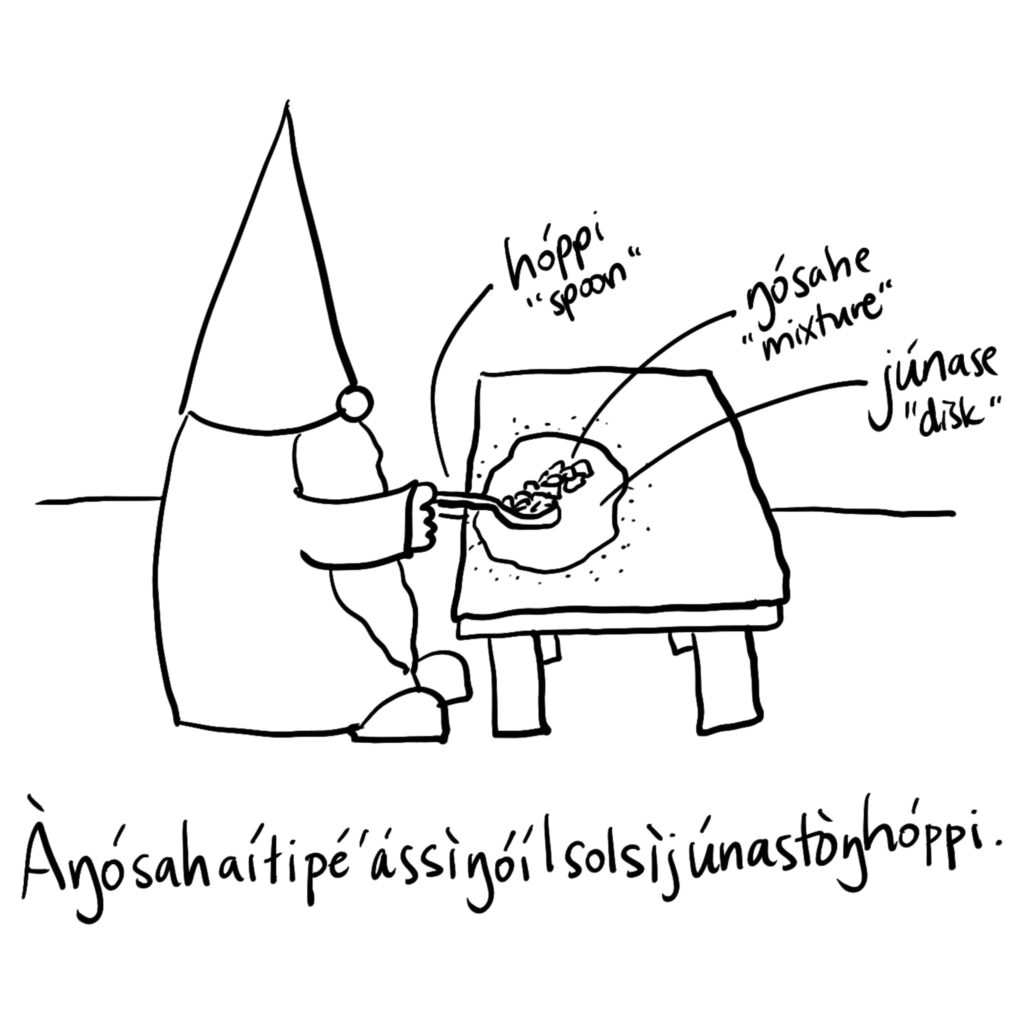
Àŋósahàsétipé’ássìŋóílsolsìjúnastòŋhóppi. “Spoon apple mixture onto half of a flattened circle of dough.”
At first, I created the verb éssoppi, which is the verbal instrumental prefix attached to the nominal root hóppi “spoon”, to create a verb meaning “to spoon”, as in today’s bit of instruction. However, the more I thought about it, the more it seemed that the verb should mean “to scoop” or “to use a spoon”, which didn’t capture the “use a spoon to get the mixture from location A to location B” reading I needed. And so I changed the meaning of éssoppi in the dictionary and used ‘áse “to put” accompanied by the preposition phrase tòŋhóppi “with a spoon” instead.
The clause starts off with the appositional noun phrases (both of which are marked as the core object since appositional phrases match in case-marking) ŋósahe “mixture” and éti “apple”. And here I notice a mistake! I have reached the stage where I think I know the language well enough to fly through translations only to realize I need to slow down as I sip my coffee and conlang during the morning hours! This should read -àséti- rather than -aíti- because the core object prefix has a final -s/h- that only occurs before vowels. If it were just a-, it would indeed be -aíti- with a shift from e to i, creating a diphthong with a rising tone. But that little reappearing consonant stops the shift.
The non-core object of ‘áse is also an appositional noun phrase, with ŋóísolo “half” and júnase “disk” occurring side-by-side and indicating where the mixture should be put.
*****
I spotted another error in yesterday’s post (beyond the missing “e” at the end): I used the word júno for “disk” but should have used júnase. Júno on its own means “moon”! The second clause should read Àwéhàmválpéhálpàjúnamíse. So many mistakes this week! It’s almost like I’ve been distracted by other things…
In case you’re wondering, I don’t fix the images because (1) it shows the mistakes along the way that naturally happen when you’re using a language that isn’t your own (and that sometimes happen even when it is your native language!), and (2) I draw the images smaller and then stretch them to fit the frame once I’ve added the text. Trying to erase and insert a new bit of handwritten text leaves the new part looking a bit wonky and out of place from the rest. In choosing between leaving in a mistake and having this visual imperfection glaring at me every time I see the image… I choose the former.