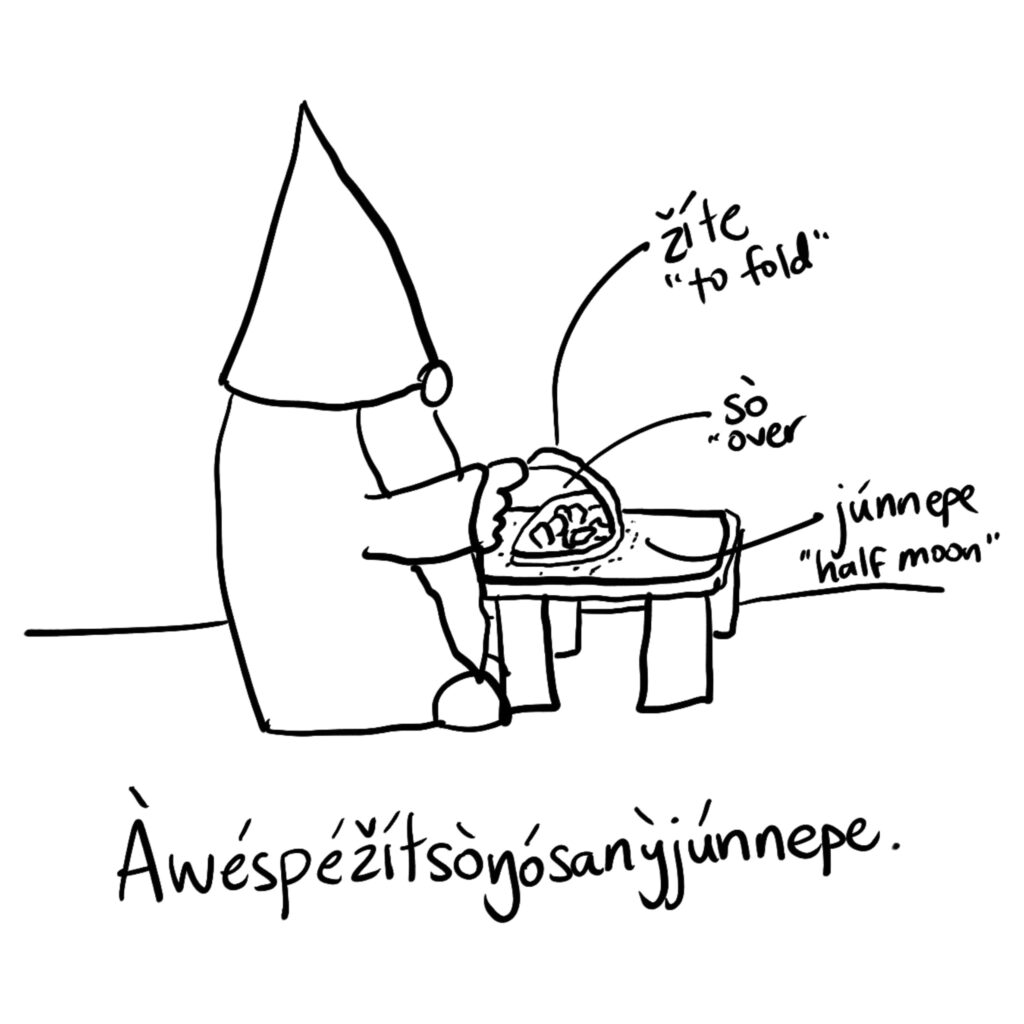
Àwéspéžítsòŋósanỳjúnnepe. “Fold dough over mixture in a half moon shape.”
Today’s Lexember entry starts with pieces already established in the language: core-object-marking à-, wése “dough”, imperative pé-, and žíte “to fold”.
Following the verb is a new preposition, sò- “over, above”, which comes from the verb sóno “to cover”. Its object is ŋósahe “mixture”, a noun used in previous Lexember entries.
Another new preposition is nỳ- “like, as”, which comes from the verb ný “to shine” (whose extended meanings include “to mirror”).
Finally, júnnepe “half moon” is another new word I created today, which led to me created words for all the major phases of the moon.
- júnsi “new moon” (lit. “dark moon”)
- júnnepefi “crescent moon” (lit. “little gap moon”)
- júnnepe “half moon” (lit. “gap moon”)
- júnnepefa “gibbous moon” (lit. “big gap moon”)
- júnna “full moon” (lit. “bright moon”)
Since the word júno “moon” was inspired by my mom’s name (June), it felt rather lovely to expand this inventory of Jun-like words.